
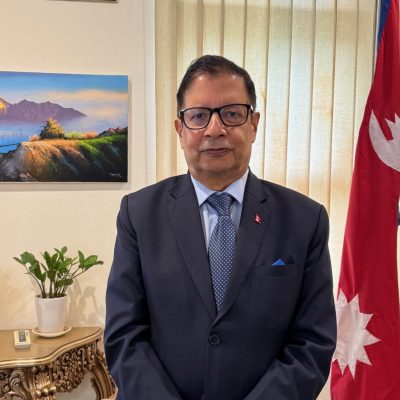
Ambassador of Nepal to India
Geographical proximity, open border, deep people-to-people ties and inherent interdependence drive Nepal-India economic relations. Along one of the world’s most porous borders, the movement of goods, services and labour fosters a shared ecosystem that often extends beyond conventional bilateral trade frameworks.
India dominates Nepal’s trade, accounting for roughly two-thirds to three-quarters of total trade. About 75% of Nepal’s exports—such as refined palm and soybean oil, polyester yarn, jute products, carpets, cardamom, tea and electricity—are sent to India. However, Nepal’s export base remains narrow and vulnerable to policy shifts, non-tariff barriers and rules of origin. Imports from India, making up 65% of total imports, include petroleum products, machinery, vehicles, medicines, iron and steel, and food items. This structural asymmetry leads to a persistent trade deficit and increased current account pressures.
India’s importance for Nepal’s future trade and investment is anchored in its proximity, large market, and deep economic integration. As Nepal’s primary trading partner and transit gateway to global markets, India offers relatively low transaction costs, shared standards and established supply chains. Leveraging this relationship is essential for Nepal’s export growth and investment expansion.

The partnership is also advancing, particularly through energy cooperation. Nepal’s hydropower potential is reshaping bilateral trade relations, highlighted by the agreement to export up to 10,000 MW of electricity to India over the next decade. This signals a transition toward a more balanced and complementary relationship.
To maximise Nepal’s exports, both countries can work together further. Non-tariff barriers can be reduced by harmonising standards, certification systems, and rules of origin. Enhancing cross-border infrastructure—including rail links, integrated check posts, dry ports and digital and harmonised customs—can lower logistics costs. Nepal must diversify exports and upgrade product quality, while India can support value chain integration and investment in key sectors.
With stable policies, regular dialogue and expanded energy trade, Nepal–India relations can evolve into a more balanced and mutually beneficial partnership.